VLC Won't Play a DVD? Setup Steps and 6 Practical Fixes

Summary: This guide explains how to play a DVD in VLC, confirm an external drive in Windows 11, and diagnose failures by symptom. It also clarifies VLC's limits with menus and protected discs, then compares its manual workflow with a dedicated DVD player.
Trying to make VLC play DVD content is easy when the source is recognized, but a physical disc can fail at the drive, disc, menu, protection, permission, or playback-setting layer. The useful first move is to identify where VLC stops instead of changing settings at random.
This guide starts with the basic VLC Media Player DVD workflow, then separates Windows 11 drive detection from actual playback and maps common VLC DVD troubleshooting symptoms to practical checks. My rule is simple: confirm the source layer first, then change the smallest setting that matches the evidence.

Play a DVD in VLC
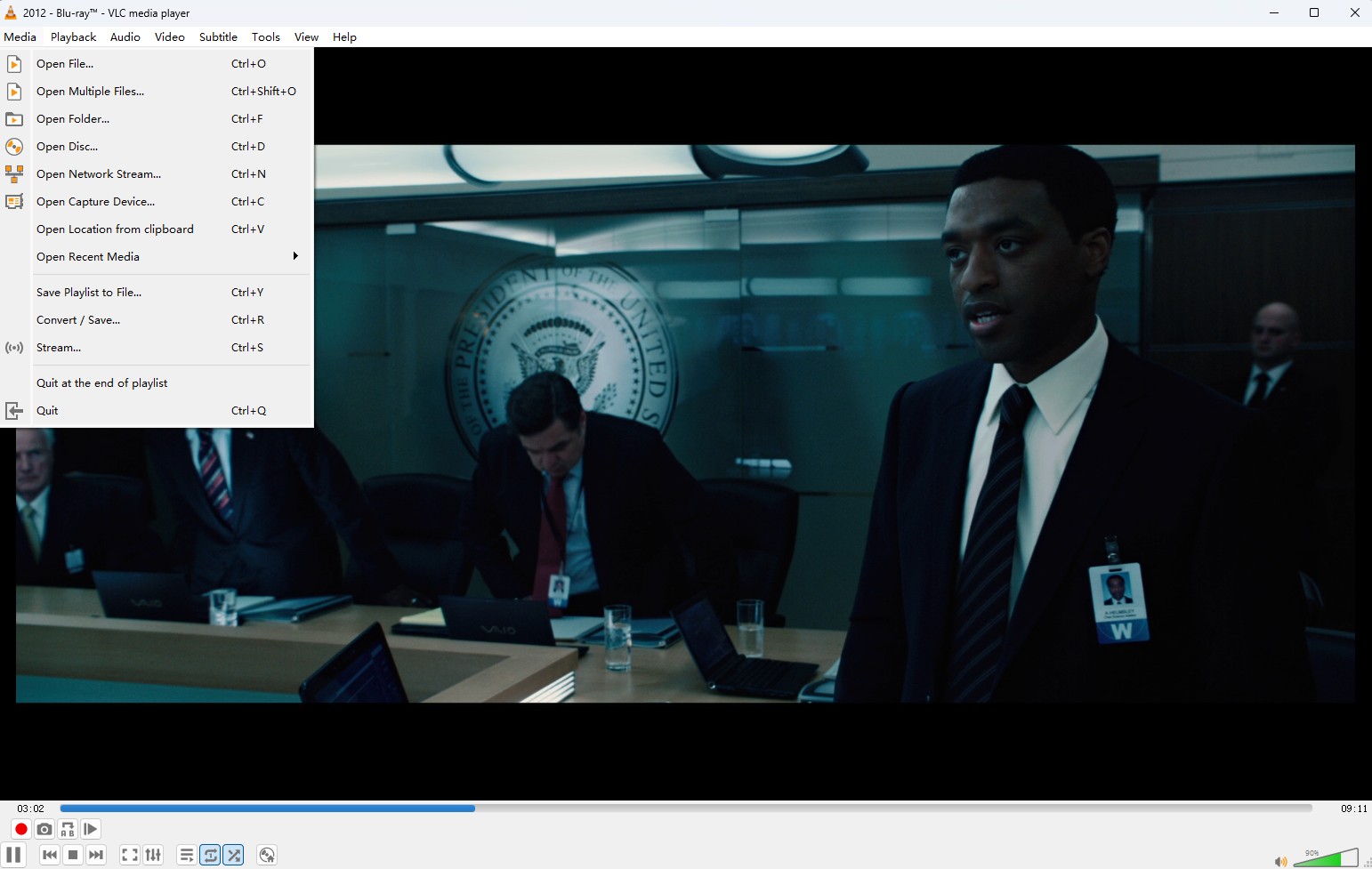
To play DVD with VLC, choose the command that matches the source: Open Disc for physical media, Open File for an ISO image, or Open Folder for a complete VIDEO_TS directory.
| DVD source | VLC command | Successful detection | First likely failure |
|---|---|---|---|
| Physical DVD | Media > Open Disc | The optical drive and DVD source appear in the Disc panel | The drive is missing, the disc is unreadable, or navigation and protection prevent playback |
| ISO image | Media > Open File | The ISO opens as a playable DVD source | The image is incomplete, damaged, or uses navigation VLC cannot interpret |
| VIDEO_TS folder | Media > Open Folder | VLC recognizes the IFO and VOB structure | The folder is incomplete or access permissions block one or more files |
The practical takeaway is that selecting the right source type prevents you from troubleshooting the wrong layer. Windows-level steps for playing DVDs on Windows 10 can confirm the system side, while the steps below stay focused on VLC.
Step 1: Access the Source Selection Menu
Launch VLC Media Player and open the Media menu. Select Open Disc for an optical drive, Open File for an existing ISO, or Open Folder for a VIDEO_TS directory.
Step 2: Target the Drive or Directory
For a physical disc, select DVD and confirm that Disc Device points to the correct optical drive. For an ISO or folder, browse to the file or to the directory containing the DVD structure. Seeing an external DVD drive in the operating system confirms detection, not successful playback.
Step 3: Configure Playback Parameters
Leave disc menus enabled when you want the full VLC DVD menu. If a menu itself is causing trouble, select No disc menus to test whether VLC can start the main title directly. This is a diagnostic choice, not a guarantee that every title or extra will work.
Step 4: Initiate the Stream
Click Play and note the exact result. A missing drive, an immediate crash, a menu that opens without a title, comb lines, and audio with a blank picture point to different layers, so the symptom should determine the next check.
Windows 11 and External DVD Drives
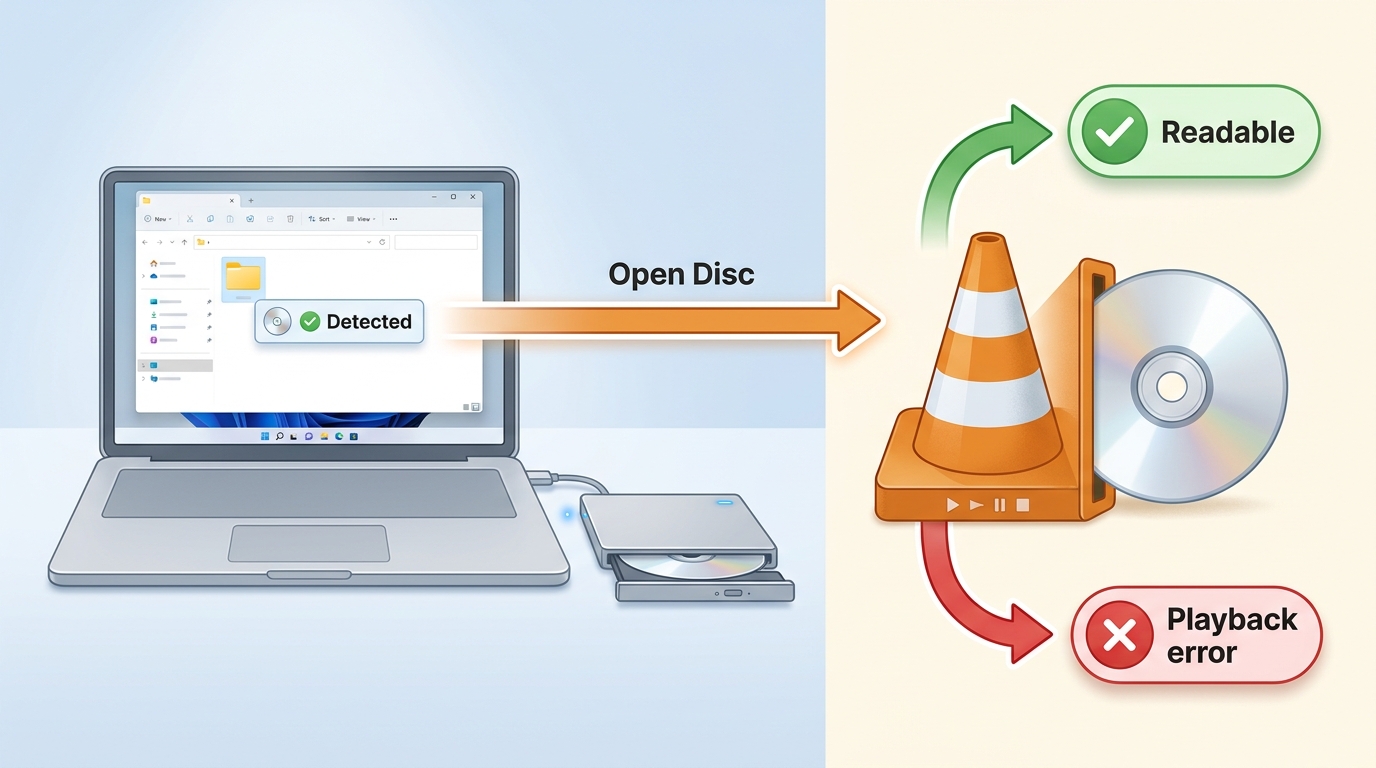
A VLC Windows 11 DVD problem should be split into hardware detection, disc readability, AutoPlay behavior, and VLC playback. Passing one check does not prove the next one will pass.
Detect the Drive Before Opening VLC
Connect the external DVD drive directly, insert a known-readable disc, and confirm that the drive appears in File Explorer or Disk Management. If the drive is absent or the disc never becomes readable, solve the hardware or Windows recognition issue before changing VLC.
On a Dell XPS 15 running Windows 11, an external optical drive that appears in File Explorer has passed the detection check, but VLC still has to open the disc structure. That observable split is why I diagnose the drive before the player.
Separate Detection from Playback
Next, check whether Windows AutoPlay opens an app, whether VLC can select the drive through Media > Open Disc, and whether the disc menu or main title starts. A detected drive with a VLC error usually shifts attention toward disc condition, permissions, navigation, region, protection, or VLC settings.
The fastest hardware-versus-configuration check is to try the same disc and USB drive on another computer. If that combination works elsewhere, the affected machine's drivers, permissions, GPU path, or VLC configuration becomes the more likely layer.
What VLC Can Play from DVD
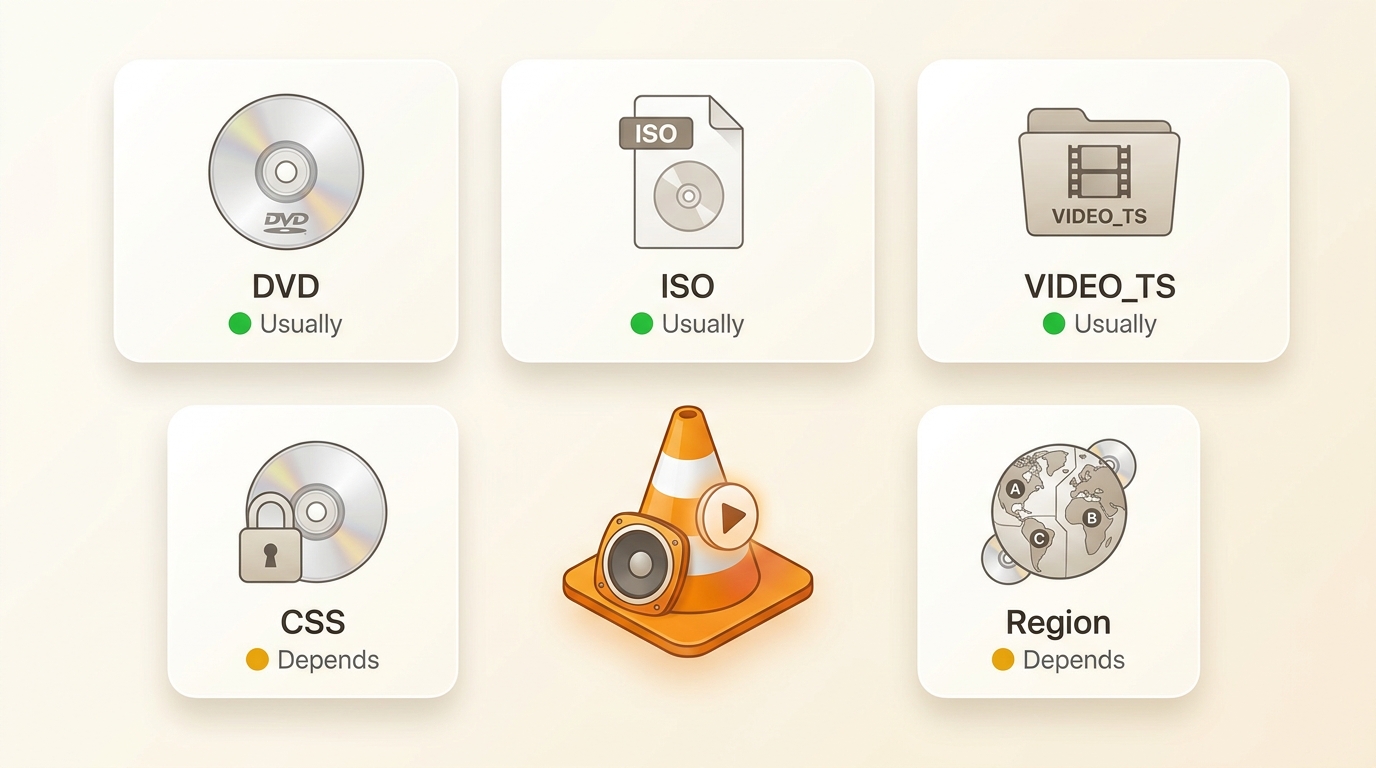
Can VLC play DVDs? It plays unprotected DVDs and common VLC DVD files directly, while CSS-protected discs, region differences, menu navigation, platform libraries, and unsupported protection can change the result.
A VLC encrypted DVD is not a simple yes-or-no case. Some authorized discs play when the appropriate DVD library is available, but a library does not guarantee compatibility with every commercial release, menu, title, or operating system.
- Unprotected physical DVDs: usually follow the standard Open Disc path.
- ISO images and VIDEO_TS folders: can work when the image or folder is complete and readable.
- CSS-protected discs: depend on the platform's DVD library support, the disc, navigation, and local legal conditions.
- Region or newer protection issues: may remain unresolved in VLC even when the drive is detected.
The same Open Disc idea applies on macOS, although drive permissions, external hardware, and disc support can differ; a dedicated DVD player for Mac page covers that platform in more depth.
Fix VLC DVD Playback by Symptom
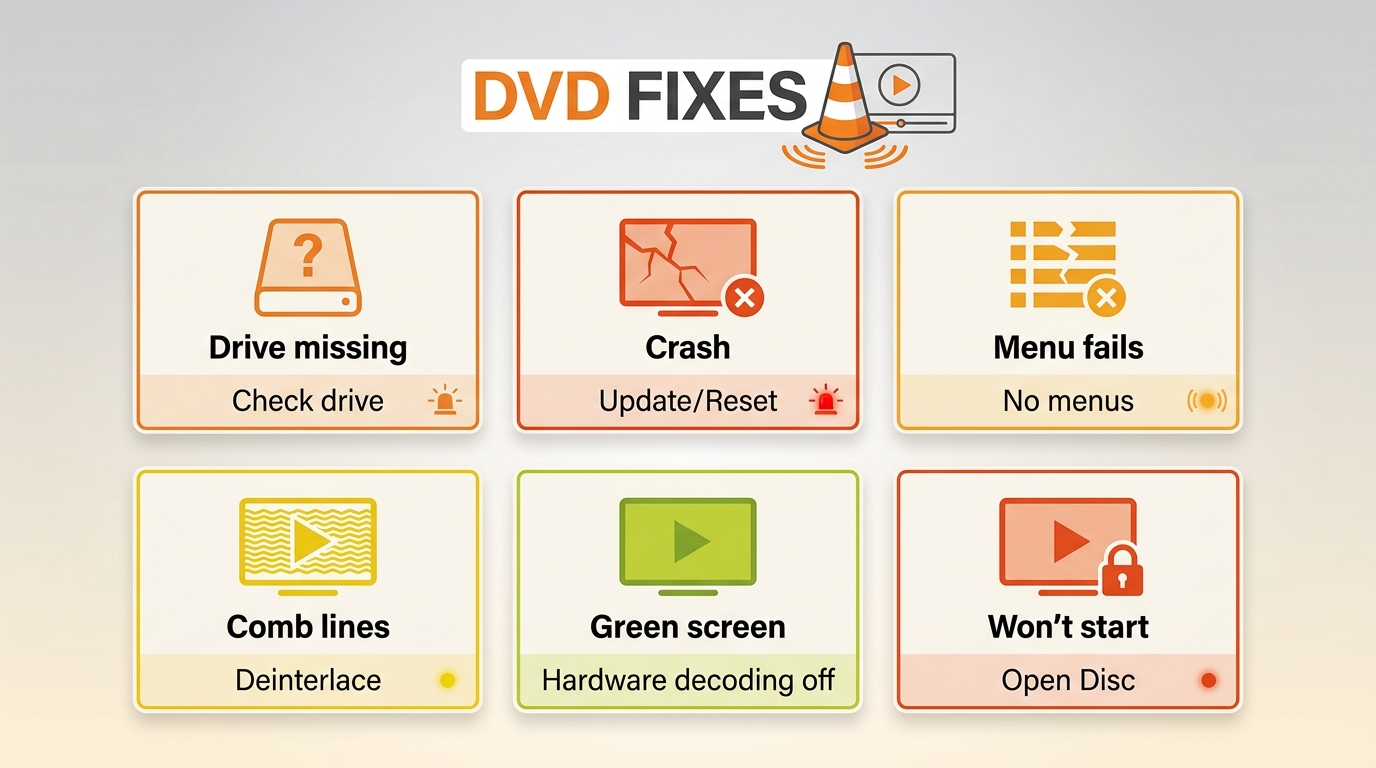
When VLC won't play DVD media, start with the visible symptom. The table narrows the likely layer before the detailed VLC DVD troubleshooting settings below.
| Symptom | Likely layer | First check | Exact fix | Fallback |
|---|---|---|---|---|
| Drive missing or disc unreadable | Hardware or Windows recognition | Confirm the drive and disc appear outside VLC | Reconnect the drive, try another port, and test a known-readable disc | Test the same drive and disc on another computer |
| Drive detected but disc will not start | Source selection, permission, region, or protection | Verify DVD and the correct Disc Device in Open Disc | Correct the source, review permissions, and use official support for authorized protected media | Try the main title without disc menus |
| VLC crashes after pressing Play | Preferences, cache, or library conflict | Open a different known-good DVD source | Update VLC, then reset preferences if the crash remains | Reinstall VLC from its official distribution |
| Menu opens but a title or extra fails | DVD navigation | Try the main feature with No disc menus | Start the title directly and avoid the failing menu branch | Use a dedicated DVD player for the authorized disc |
| Stutter or comb lines during motion | Deinterlacing or output path | Pause on a fast-moving scene and look for horizontal edges | Set deinterlacing to Automatic and compare an appropriate mode | Return to default video settings and test again |
| Audio with a black or green screen | GPU decoding path | Play a local video to see whether the issue is DVD-specific | Disable hardware-accelerated decoding for the test | Update the graphics driver or use CPU decoding |
Once the symptom identifies a layer, make one change and retest. This keeps the diagnosis readable and prevents a successful fix from being hidden by several simultaneous changes.
Check DVD Libraries and Protection
For personal media you are authorized to access, where permitted by applicable law and relevant terms, VLC may depend on platform-appropriate DVD libraries for some protected discs. Treat the library as a compatibility dependency, not a universal key.
On Windows, consult the official VideoLAN project documentation rather than downloading a DLL from an unverified search result. On Debian or Ubuntu, rely on trusted operating-system package documentation and confirm device permissions. This article intentionally stops at compatibility principles and does not provide installation commands, file locations, or acquisition steps.
If an authorized commercial disc still fails, the responsible next step is the disc publisher, retailer, drive manufacturer, or official VLC support channel. Region, navigation, and unsupported protection can remain relevant even when a DVD library is present.
Enable Deinterlacing to Fix Comb Lines
Before changing the setting, pause on movement and confirm that the picture shows horizontal comb-like edges rather than general blur or stutter. If the symptom matches, go to Tools > Preferences > Video and set Deinterlacing to Automatic, then compare the available mode with the default.
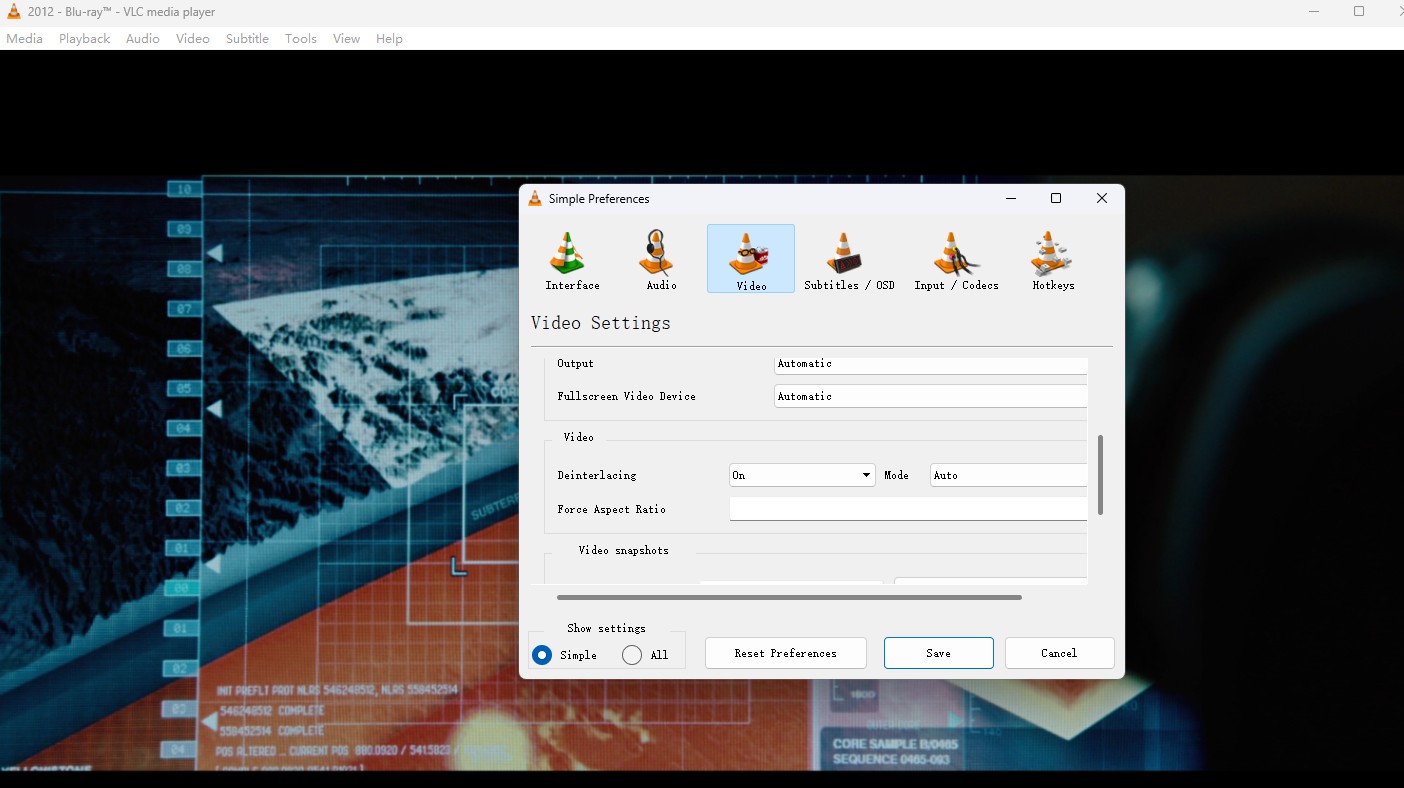
On an LG C2 OLED connected to a Windows 11 PC, comb lines that appear mainly during motion point to interlaced DVD video rather than a drive fault. Deinterlacing can smooth motion, but an aggressive mode may add processing load or soften fine detail.
Reset Preferences and Update VLC
First test a known-good local file and a second DVD source. If VLC fails broadly after an operating-system or driver change, use Help > Check for Updates. If the DVD issue remains, open Tools > Preferences and choose Reset Preferences.
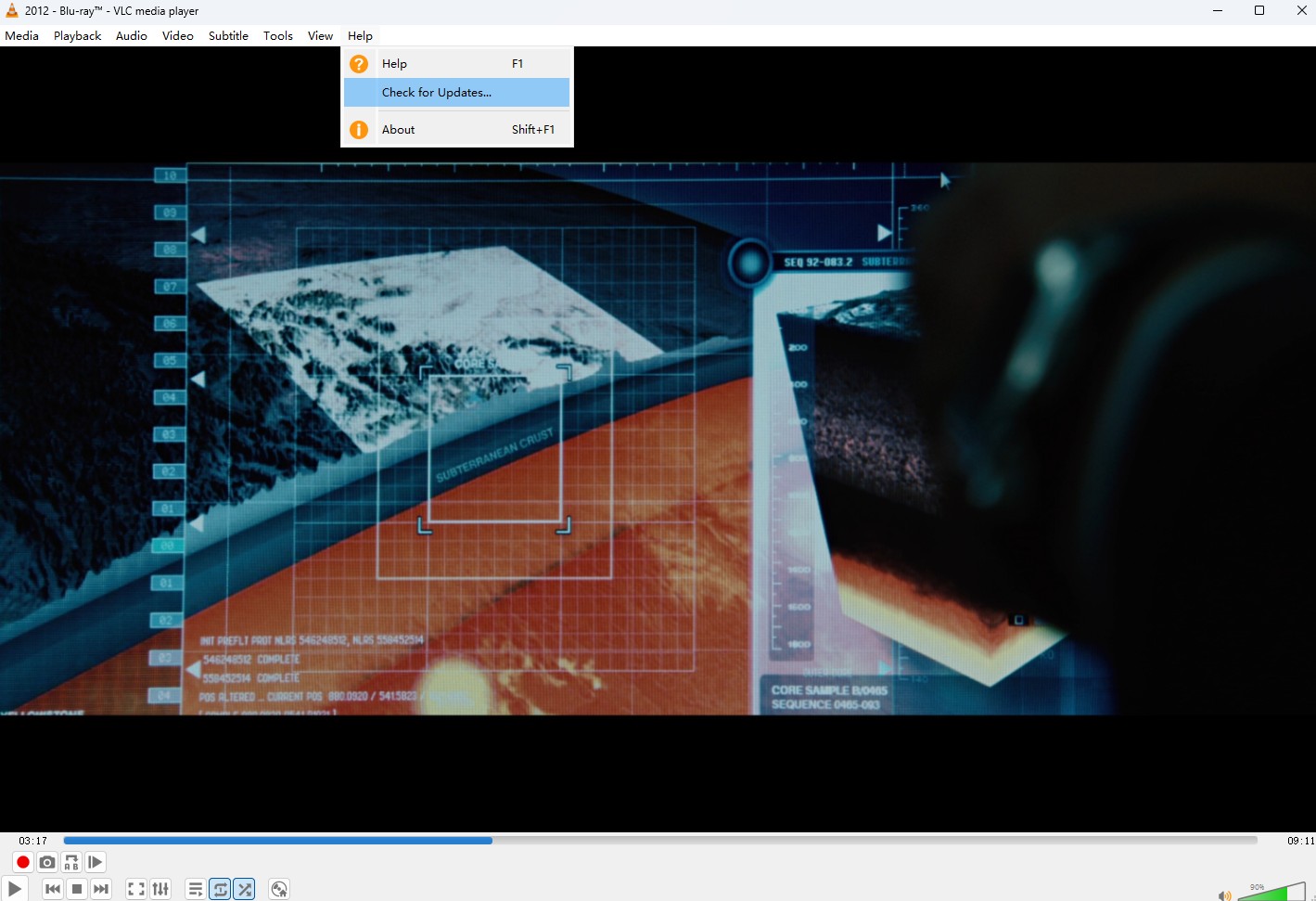
A reset clears custom output, codec, and navigation choices, so note any settings you need before using it. My preference is to reset after source and drive checks, because configuration is easier to rebuild than a mistaken hardware diagnosis.
Disable Hardware Decoding for Green Screens
Test whether a regular local video displays correctly, then open Tools > Preferences > Input / Codecs and disable hardware-accelerated decoding for one DVD test. If the picture returns while audio remains stable, the GPU decoding path was the likely conflict.
On a Dell XPS 15 with an NVIDIA RTX 4060 running Windows 11, audio with a black or green picture is a useful GPU-path symptom, not proof of a damaged disc. CPU decoding can improve compatibility, but it can also increase processor use, especially on older machines.
VLC or a Dedicated DVD Player?
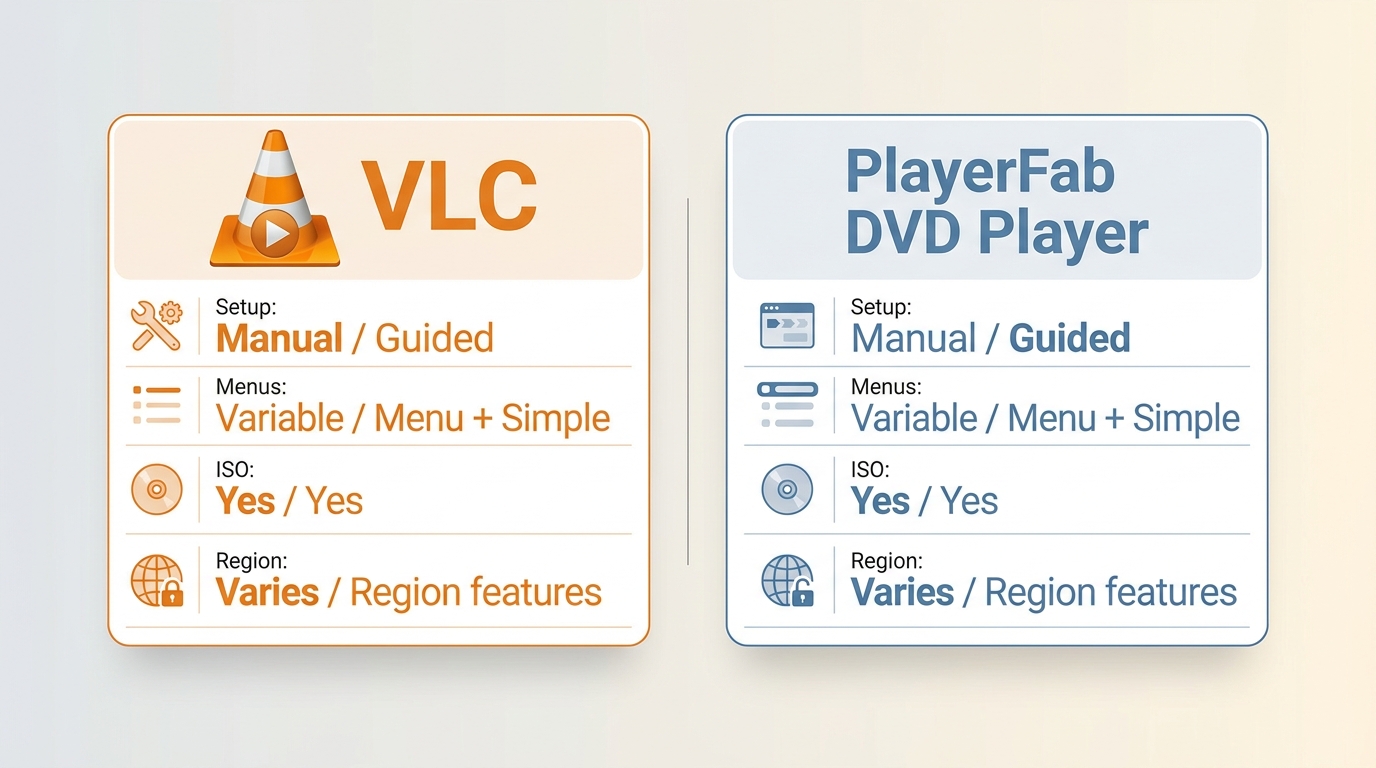
VLC is a flexible, free VLC DVD player for readers comfortable with source and settings diagnosis. A dedicated player can suit readers who want a more guided disc and VLC DVD menu workflow.
| Player | Initial setup | Commercial-disc compatibility | DVD menu behavior | Region handling | ISO and VIDEO_TS support | Local-library options | Best fit | Not ideal for |
|---|---|---|---|---|---|---|---|---|
| VLC media player | Install VLC, select the correct source, and diagnose libraries or settings when needed | Varies by disc, platform, region, navigation, and available DVD libraries | Menus may work, while some titles or extras can fail | Depends on the drive, disc, platform, and local configuration | Opens existing ISO images and complete VIDEO_TS folders | Basic file and playlist organization | Readers who want free, flexible playback and manual control | Readers who do not want to diagnose libraries, menus, or settings |
| PlayerFab DVD Player | Dedicated disc interface for Windows and macOS | Designed for physical DVDs, ISO images, and DVD folders used within authorized access | Menu Mode is available for DVD navigation, with Simple Mode for direct main-title playback | Includes region-handling features within its disc workflow | Supports physical DVD, ISO, and folder sources | Poster-wall library, metadata matching, and disc-to-ISO library import | Readers who prefer a guided disc workflow and a managed local library | Readers who want an open-source player or need streaming-platform playback |
The practical choice is about troubleshooting tolerance. VLC offers more manual control at no software cost, while PlayerFab concentrates disc navigation and library tasks in a dedicated interface. Neither fit should be stretched into a universal recommendation.
Play DVDs with PlayerFab
After VLC source, drive, and settings checks are exhausted, PlayerFab is a dedicated playback option for discs and local media you are authorized to access, where permitted by applicable law. Its relevant distinction here is the guided DVD workflow, not a promise that every disc condition will disappear.
- Open PlayerFab and insert the DVD. Select the detected disc from the Discs area.
- Choose Menu Mode when you need DVD navigation, or Simple Mode when you want to start the main title directly.
- For an authorized ISO image or DVD folder, drag the source into the interface or locate it through the built-in file browser.
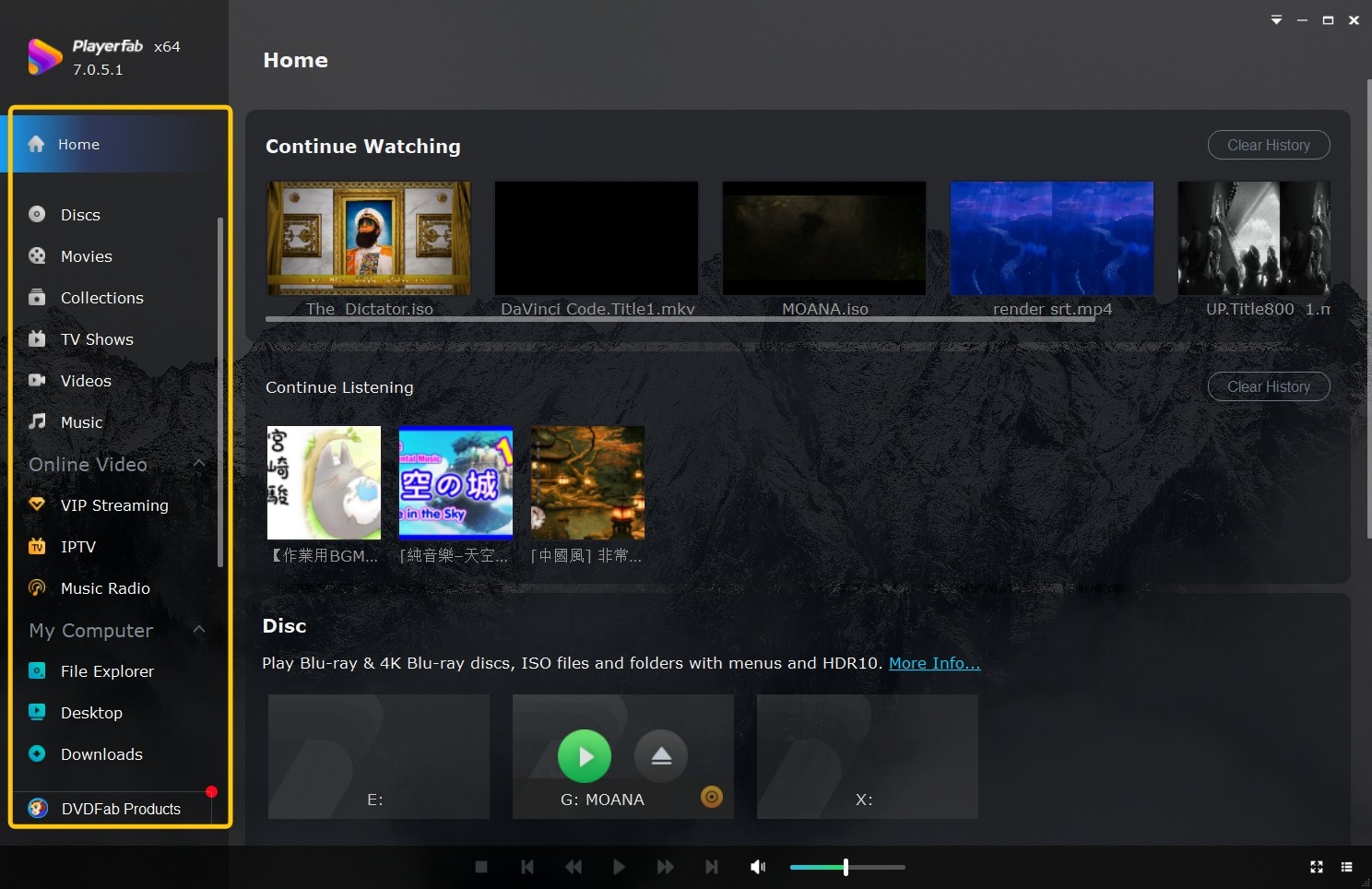
If you want to confirm the interface on your own system, the existing Free Trial for Windows and Free Trial for Mac links provide the platform-specific installers.
PlayerFab is less suitable if you want open-source software, minimal library features, or streaming-platform playback. Its DVD Player workflow is aimed at physical discs and local DVD media rather than online services.
Final Verdict
VLC play DVD workflows suit readers who want a free, flexible player and are comfortable diagnosing the source, drive, library, menu, and settings layers. A dedicated DVD player suits readers who value a guided disc workflow and local-library controls.
VLC is not ideal when recurring menu or compatibility diagnosis costs more time than the free software saves. PlayerFab is not ideal for readers who prefer open-source tools or need streaming playback. I would choose after the basic VLC checks, because the remaining friction shows which trade-off matters.
FAQ
These answers cover the adjacent setup questions without turning playback into a copying or hardware-repair guide.
How can I make VLC open a DVD automatically in Windows 11?
Configure Windows 11 AutoPlay to prompt for or launch VLC when a DVD is inserted, then keep Media > Open Disc as the reliable manual path. AutoPlay can select the app, but it does not prove that VLC can navigate or play a particular disc.
Can VLC convert a DVD to MP4 or save it as an ISO?
Playback, transcoding, and disc-image creation are separate jobs. VLC can transcode some unprotected video sources, but it is not a full DVD-authoring or ISO-backup workflow. Limit conversion or personal backup work to media without protection or media for which you clearly hold copying permission.
Can VLC play DVDs on a Mac?
Yes, the basic Open Disc flow is similar on macOS. The result still depends on the external drive, permissions, disc condition, navigation, region, protection, and platform DVD libraries, so drive recognition should be checked separately from playback.
What can I do if my computer has no DVD drive?
Use a compatible external USB optical drive, or open an authorized local ISO or DVD folder that you already have permission to use. VLC needs the physical drive or local source to appear correctly before the player can begin reading the DVD structure.

 Play Video Files: 4 Paths Across Formats and DevicesBy James Morgan - Sep 22, 2026
 12 Best HEVC Players for Windows, Mac, and 4K (2026)By Alice Harper - Aug 4, 2026
 Best WMV Player for Mac and How to Play WMV on Mac NativelyBy James Morgan - Aug 4, 2026
 8 Best TS File Players and Playback Tools for 2026By Alice Harper - Jul 28, 2026