Multi-Disc Blu-ray Player Status: Why They're Rare & Modern Alternatives

Summary: True multi-disc Blu-ray players, devices that physically store and automatically play multiple discs, have been discontinued since 2014. The market moved from mechanical disc changers to single-disc universal players and digital streaming solutions. For those seeking to manage large collections, this guide covers historical context, rare used market options, and modern alternatives for 2026.
Table of Contents
Many physical media collector reach out to me looking for a recommendation on a new multi-disc Blu-ray player. They have hundreds of discs and want the convenience of an automated library without sacrificing the uncompressed bitrate of physical media. I have to deliver the same blunt reality check: true multi-disc Blu-ray players have been discontinued.
In this guide, I will explain why the industry abandoned these mechanical behemoths, analyze the risks of the current used market, and walk you through the digital alternatives we use in 2026 to manage large media collections effectively.
The Reality of Multi-Disc Blu-ray Players
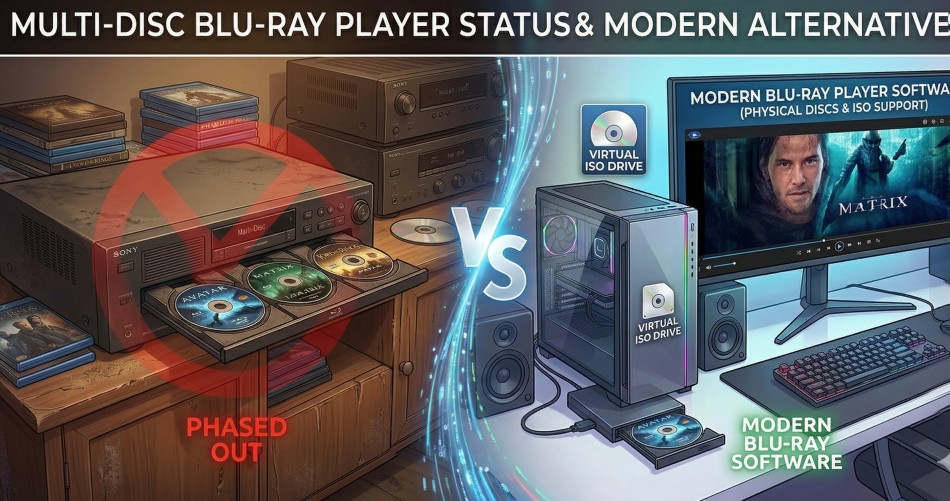
The pinnacle of this hardware category was the Sony BDP-CX7000ES, released back in 2010. It boasted a massive 400-disc capacity and carried a flagship retail price tag of $1,999. While it was an impressive piece of machinery for its time, Sony officially discontinued its entire multi-disc changer lineup by 2014, taking popular models like the DVP-CX995V DVD changer series down with it.
Looking at the market status in 2026, the situation is completely static:
- Zero new production: No manufacturer is currently producing multi-disc Blu-ray changers.
- No upcoming releases: There have been zero announcements at recent tech trade shows indicating any revival of this form factor.
- Hardware degradation: The original mechanical components in these devices were designed with a specific lifespan, and they have now exceeded their 10-year design limit.
Anyone looking to acquire a multi-disc player today is forced to rely on the used market, navigating private sellers and a dwindling eBay inventory. But before you consider hunting down a decade-old machine, it helps to understand the hardware and standard limitations that caused this product category to fail in the first place.
Why the 400-Disc Blu-ray Changer Failed
When a standard single-disc player fails on my test, the issue is usually straightforward. A single-disc player operates with around 50 primary components. However, the multi-disc changers produced before 2014 are entirely different beasts.
The Mechanical Cost of a 400-Disc Capacity
To achieve the automated rotation and loading of hundreds of discs, machines like the Sony CX series required between 250 and 400 individual components. Every gear, rubber belt, and moving tray introduced a new potential point of failure.
In these machines, the optical laser assembly had to physically travel and align with a massive rotating carousel. Over a 10,000-cycle lifespan, the alignment inevitably drifted, and the rubber drive belts degraded. This extreme mechanical complexity drove the failure rate to be 3 to 5 times higher than standard players, resulting in a massive 15-20% warranty return rate within just the first two years of operation. Ultimately, the manufacturing cost of $400-$800 per unit simply became unsustainable for manufacturers.
HDCP 2.2 and 4K Obsolescence
Even if you managed to keep the internal mechanics of a multi-disc player running perfectly, the digital handshake standards moved on without it. The evolution of HDMI standards (from 1.4 to 2.0 to 2.1) gradually isolated these older players.
More critically, the introduction of the HDCP 2.2 requirement in 2015 created a hard physical barrier. Because these multi-disc players predate this strict anti-piracy protocol, they are completely incompatible with modern 4K UHD content. You cannot bypass this with a firmware update; the physical hardware simply cannot decode the discs.
Buying a Used Multi-Disc Blu-ray Player
Because production ceased in 2014, the only way to acquire one of these units today is through private sellers. While it is tempting to buy a used unit to house an existing physical library, the hardware reality makes this a highly volatile investment.
Current Prices for the Sony BDP-CX7000ES and DVP-CX995V
When tracking the secondary market, inventory is incredibly thin. At any given time, there are typically only 8 to 12 units of the 400-disc Blu-ray capable Sony BDP-CX7000ES available globally on eBay, usually priced between $400 and $800 depending on the exterior condition.
If you are only looking to store standard definition discs, the DVD-only Sony DVP-CX995V pops up more frequently (around 15-25 units available) and ranges from $150 to $300. However, these are strictly limited to the DVD format and are easily over 15 years old.
The Refurbished Illusion and Repair Realities
Listings marked as "Used / Working" or "Seller Refurbished" rarely tell the whole story. A seller might replace a broken drive belt and clear out dust, but they cannot replace a degraded optical laser assembly. Sellers typically only offer a 14 to 30-day warranty, which is inadequate for a complex mechanical device nearing its second decade.
When evaluating listings, red flags are easy to spot. A seller noting "Powers on, have not tested disc loading" translates to a 50% risk of immediate failure. Even if a unit arrives perfectly functional, my assessment based on the hardware age is that there is a 60-70% probability of a mechanical failure within the first 12 months of daily use.
Modern Alternative to Multi-Disc Blu-ray Players
Instead of fighting with 15-year-old carousels and failing lasers, the modern approach to handling massive media libraries splits the problem: reliable single-disc playback for physical media, and 1:1 digital ISO backups for mass storage.
Single-Disc Universal Players
The most direct replacement for a broken changer is a high-quality universal player paired with an efficient physical cataloging system. I use the Sony UBP-X800M2, which retails for $250 to $300. It supports seven different formats, including Blu-ray, 4K UHD, DVD, CD, SACD, and DVD-Audio.
By pairing a $300 player with high-capacity storage like Atlantic 100-disc binders ($25-$30) and a cataloging app like CLZ Movies, you can eliminate the mechanical failure risks associated with old changers. This manual process is faster and more reliable than waiting the 45 to 60 seconds it took for a multi-disc changer mechanism to rotate and load.
For a budget single-disc option, readers considering whether PS4 plays Blu-ray discs should know that the console supports standard Blu-ray media but cannot play 4K UHD Blu-ray discs.
PlayerFab Ultra HD Player
When collectors realize a standalone multi-disc changer is no longer a viable hardware option, many transition their setups to a Home Theater PC. However, the immediate technical bottleneck is that modern operating systems like Windows natively lack the decoders and Java runtime environments required to read physical Blu-ray discs, let alone 4K UHD discs.
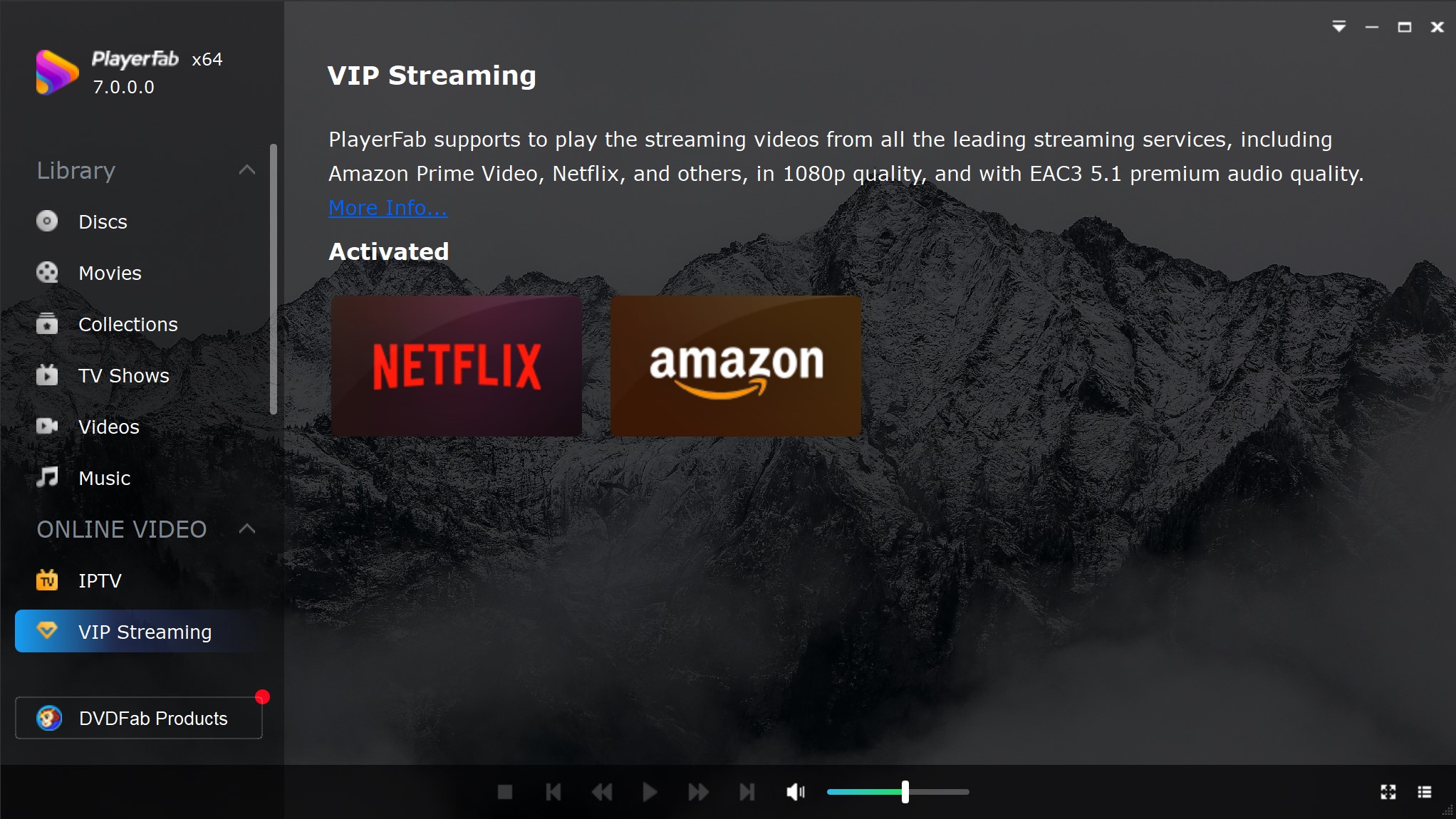
To solve this specific decoding issue, I use PlayerFab Ultra HD Player. This software turns a standard PC drive into a high-capability universal player.
- Bypasses OS limitations to read physical DVDs, Blu-rays, and 4K UHD discs directly. It fully renders BD-J menus, preserving original navigation and alternative tracks
- Replaces the mechanical changer database by automatically scraping metadata (posters, cast) for local files and physical discs.
- Decodes high-efficiency codecs (H.265/HEVC, H.264) and standard containers (M2TS, MOV, VOB, FLV). For 3D playback, it natively handles frame-packed 3D Blu-rays, 3D ISOs, and SBS/Top-Bottom formats.
- Bypasses the OS audio mixer to output spatial and high-res audio (Dolby Atmos, DTS:X, Dolby TrueHD, DTS-HD Master, FLAC, AC3 5.1) directly to your AV receiver.
- Accurately passes through dynamic metadata for Dolby Vision and HDR10 to compatible displays, properly handling peak brightness parameters up to 1000 nits.
Conclusion
The era of the multi-disc Blu-ray player ended over a decade ago. I cannot recommend spending $400 to $800 on used mechanical changers. They carry a massive risk of hardware failure and lack the necessary HDCP 2.2 protocols for modern 4K playback. The most practical solution for managing a large media library today is a hybrid approach. By combining a reliable modern single-disc player with a software hub like PlayerFab, you eliminate the risk of mechanical degradation.

 6 Best MPEG Players for Windows and Mac (2026)By Alice Harper - Aug 26, 2026
 How to Play Blu-ray Discs on Windows 10 (Free & Pro Solutions)By Alice Harper - Aug 7, 2026
 10 Best 4K Video Players for PC and Mac, Tested in 2026By Alice Harper - Aug 4, 2026
 The 5 Best Free MOV Players in 2026 (Windows, Mac and Android), plus How to FixBy Alice Harper - Aug 4, 2026